• Which the release of FS2020 we see an explosition of activity on the forun and of course we are very happy to see this. But having all questions about FS2020 in one forum becomes a bit messy. So therefore we would like to ask you all to use the following guidelines when posting your questions:

    • Tag FS2020 specific questions with the MSFS2020 tag.
    • Questions about making 3D assets can be posted in the 3D asset design forum. Either post them in the subforum of the modelling tool you use or in the general forum if they are general.
    • Questions about aircraft design can be posted in the Aircraft design forum
    • Questions about airport design can be posted in the FS2020 airport design forum. Once airport development tools have been updated for FS2020 you can post tool speciifc questions in the subforums of those tools as well of course.
    • Questions about terrain design can be posted in the FS2020 terrain design forum.
    • Questions about SimConnect can be posted in the SimConnect forum.

    Any other question that is not specific to an aspect of development or tool can be posted in the General chat forum.

    By following these guidelines we make sure that the forums remain easy to read for everybody and also that the right people can find your post to answer it.

FSXA AirWrench vs. AirWizEd vs. Spreadsheet

Heretic

Resource contributor
Messages
6,830
Country
germany
When you think you have pretty good tools to work your flight dynamics out with, you get the most odd behavior.

See the yellow highlights here (yellow highlight that is not a colored cell in the spreadsheet):
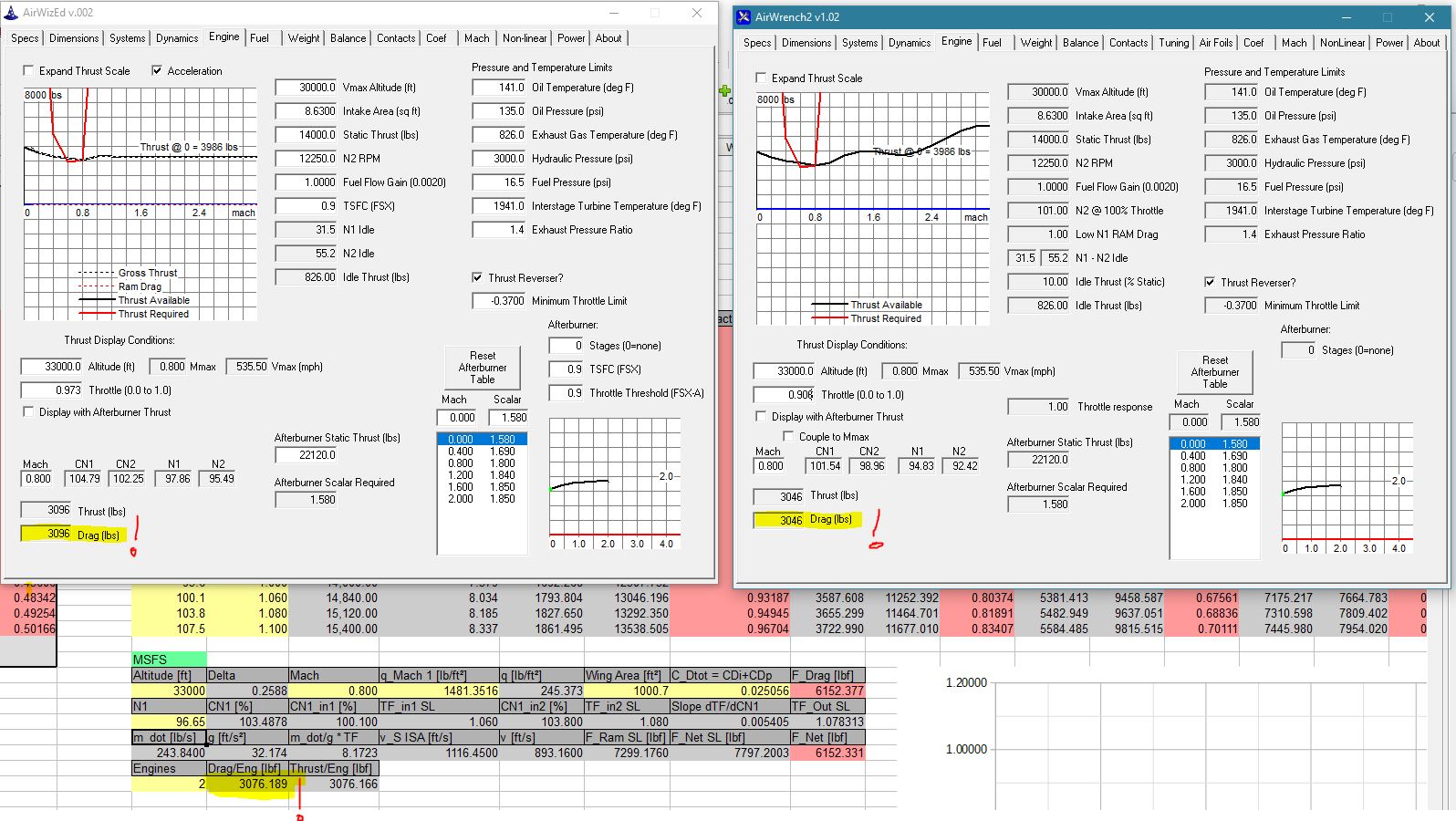
AirWrench_AirWizEd_Calc.JPG


As you can see, all three tools show different values for drag.

AirWizEd and AirWrench use the exact same AIR file. The AIR file was produced from an ASM file which was filled with the tables produced in the spreadsheet.
No modifications were made in either tool except for the setpoint in the "engines" tab.
Aircraft.cfg relevant information does not differ between all three tools.
The setpoint itself (Mach 0.8) was deliberately chosen because it's shared by table 154a and table 1506 and no interpolation is necessary.
Table 154a was produced from a drag polar and accounts for induced drag as determined from table 404.
In the spreadsheet the drag value is calculated according to FSX' method (F_D=q*s_w*C_Dtot).

That there's disagreement between the spreadsheet and other tools is not surprising due to rounding and interpolation errors. That the resulting drag in both external tools differs by 50 lbf (or 1.6%), however, is.

I sadly don't know the build date of either AirWizEd and AirWrench, so I don't know which tool is more up to date and more likely to be trusted.

Maybe I'll get lucky in FSX and hit the setpoint just right on a test flight to see which of the three drag figures is closest.

I'm still amused that even development tools work by the "Opinions are like noses - everybody's got one" principle. :tapedshut:laughing:


- Edit:

Noted that my AirWrench version is out of date. Updated to 1.03 (0.003 for AirWizEd), but the discrepancy persists.
 
Well, one difference is that AirWiz has Acceleration selected and it appears that AirWrench is using the pre-FSXA thrust model.
You can set AirWrench to use acceleration on the Tuning page. There are 8 choices for the sim there and you need to check which is selected.

In FSXA there is no extrapolation of the thrust calculations above Mach 1. Hence the thrust line is flat above Mach 1 in AirWiz.
In FSX there is extrapolation above Mach 1 as witnessed by the varying thrust above Mach 1 in AirWrench.
Also FSXA will use 154a for drag. Prior to FSXA the Mach drag was in 430.
An evaluation program set up for FSX will not use 154a.

And induced drag is calculated separately from Mach and form drag so It is unusual to have it as part of CDm. You would be double dipping adding it into Mach drag in 154a which is probably why the AirWiz drag is higher.
If the drag is slightly different, then for the same Mach thrust will be different and require a difference throttle setting, which you have.
You should check if they have the same thrust at the same Mach and throttle setting. That would point to a difference in drag computation.
What happens in flight test?
I imagine Jerry Beckwith could answer the question
However the FSX versus FSXA and different Mach tables could account for the differences. The Spreadsheet, if it is Flight Dynamics Workbook precedes AirWrench and certainly has no 154a capability
Roy
 
Well, one difference is that AirWiz has Acceleration selected and it appears that AirWrench is using the pre-FSXA thrust model.
You can set AirWrench to use acceleration on the Tuning page. There are 8 choices for the sim there and you need to check which is selected.

In FSXA there is no extrapolation of the thrust calculations above Mach 1. Hence the thrust line is flat above Mach 1 in AirWiz.
In FSX there is extrapolation above Mach 1 as witnessed by the varying thrust above Mach 1 in AirWrench.
Also FSXA will use 154a for drag. Prior to FSXA the Mach drag was in 430.
An evaluation program set up for FSX will not use 154a.

Good point, however setting AirWrench to FSX-A doesn't change anything.
My airfile was built with 154a since I don't know the headers and required table size format for 430 in ASM format and regarding of simulator setting, AirWrench seems to read it.
Besides, having 430 or 154a doesn't make a difference at mach 0.8 since both tables share drag data for that mach number.

And induced drag is calculated separately from Mach and form drag so It is unusual to have it as part of CDm. You would be double dipping adding it into Mach drag in 154a which is probably why the AirWiz drag is higher.

I've taken that into account. 154a only handles the drag delta due to Mach (as it should), while 1540 has C_D0 corrected for induced drag.
Induced drag was calculated from a few flight situations across the operating range (high weight, low alt, low mach to low weight, high alt, high mach) and then averaged out.
Using a C_Di for a typical cruise AoA and C_L, the previously calculated average C_Di is a pretty good match. Any differences would account for the discrepancy between spreadsheet and simulator.

[quot]If the drag is slightly different, then for the same Mach thrust will be different and require a difference throttle setting, which you have.
You should check if they have the same thrust at the same Mach and throttle setting. That would point to a difference in drag computation.[/quote]

See the thrust values here:

AirWrench_AirWizEd_Calc2.JPG


Disregarding rounding, I'd say it's an exact fit.

What happens in flight test?

Good question; I didn't get that far yet. Had to spend too much time with table 1505 to get the spool curve right.

And as posted, hitting an exact number in MSFS is a bit of hit & miss.

I imagine Jerry Beckwith could answer the question

Yep, that's where I'd take the issue if a flight test brings no closure.

However the FSX versus FSXA and different Mach tables could account for the differences. The Spreadsheet, if it is Flight Dynamics Workbook precedes AirWrench and certainly has no 154a capability

Jerry's FDWB didn't work for me in Libreoffice due to all the macros involved, so the spreadsheet is homegrown, made to FSXA/ESP/P3D standard for easy copy-and-paste into ASM files and the aircraft.cfg and based on Yves' and your methods and equations. It's nowhere near as complex as Jerry's tools and limited to jet aircraft lift, drag and thrust (at the moment).
Yet, ever since figuring out how to implement a rudimentary linear interpolation capability, a few tables are able to predict the consequences of changes to the tables without compiling the AIR file and checking it in other tools or MSFS.
After including all relevant tables and parameters, I figure that I could even implement a full blown "flight test" page, calculating all forces and moments observable in MSFS as specified by Yves. But that'd take quite a bit of extra time.
 
In the examples in both your posts, Airwiz has less drag than AirWrench. The thrust computations are identical.
In your second example using full throttle MMax is showing 0.804 with AirWiz and 0.801 with AirWrench. That is a sign of greater drag with AirWrench.
So whatever AirWrench used for drag computation it is different in your examples than whatever AirWiz uses. Mind you the difference is trivial. If your version of AirWrench is old, it might not be reading 154a and it does use a sort of default 430 occasionally.

while 1540 has C_D0 corrected for induced drag
I'm not sure you can do that. CD_0 has a set value for all speeds. CD_I varies with speed, but mainly with CL, High CL = high CDI. AirWiz computes CDI as a component of total drag. For example if you plot the value of drag at a particular weight and altitude with full dry thrust, you will find as you examine lower speeds that you get down to a value where drag equals thrust. This defines minimum speed due to induced drag or the left hand side of the 1g envelope. The right side is where drag again equals thrust and the drag is due to CD0 and CDMach. If Mach does not come into play the right side is almost totally due to CD0 in the usual drag equation. CDI is minimal at low AOA and high speed but high at high AOA and low speed. It absolutely is different from CD0 and In my view should be dealt with separately.

[QUOTE="Besides, having 430 or 154a doesn't make a difference at mach 0.8 since both tables share drag data for that mach number."[/QUOTE]
I thought you said you did not use 430. It can have whatever values you enter as can 154a so why would they necessarily share the same 0.8 M values?

In Flight test on Max Mach runs such a small difference would probably be unnoticed. I do the runs for about one minute and check on Z acceleration plus whether the thrust value is increasing. When thrust becomes static I record that Mach.
Sometimes the rise in thrust with Mach and the rise in drag are almost parallel and just a tad extra thrust barely makes a difference in the Max speed.
Very interesting work and I'd love a copy of your spreadsheet.
Roy
 
In the examples in both your posts, Airwiz has less drag than AirWrench. The thrust computations are identical.
In your second example using full throttle MMax is showing 0.804 with AirWiz and 0.801 with AirWrench. That is a sign of greater drag with AirWrench.
So whatever AirWrench used for drag computation it is different in your examples than whatever AirWiz uses. Mind you the difference is trivial. If your version of AirWrench is old, it might not be reading 154a and it does use a sort of default 430 occasionally.

As stated in the edit of my original post, I've updated both AirWiz and AirWrench to the latest version (1.03).

I'm not sure you can do that. CD_0 has a set value for all speeds. CD_I varies with speed, but mainly with CL, High CL = high CDI. AirWiz computes CDI as a component of total drag. For example if you plot the value of drag at a particular weight and altitude with full dry thrust, you will find as you examine lower speeds that you get down to a value where drag equals thrust. This defines minimum speed due to induced drag or the left hand side of the 1g envelope. The right side is where drag again equals thrust and the drag is due to CD0 and CDMach. If Mach does not come into play the right side is almost totally due to CD0 in the usual drag equation. CDI is minimal at low AOA and high speed but high at high AOA and low speed. It absolutely is different from CD0 and In my view should be dealt with separately.

The drag data I have from the real aircraft does not discriminate between C_Dp and C_Di, so if I used the C_D0 value stated there and didn't adjust for C_Di, I would obtain more drag than necessary in FSX.
For a cruise configuration (no flaps, gear and spoilers) without yaw (beta) influence, Yves states that:
C_Dtotal = C_D0+C_Di = (C_D0+C_Dp)+C_Di
C_D0 is sourced from table 1101/1540, C_Dp is from table 430/154a and C_Di is computed by MSFS from table 404.

Maybe my understanding and terminology is a bit off, but that's how I set everything up.

I could revert to the published base value for C_D0 alright and simply adjust thrust accordingly. Not much of a problem.

I thought you said you did not use 430. It can have whatever values you enter as can 154a so why would they necessarily share the same 0.8 M values?

Ah, I see I wasn't clear enough. Table 154a, in my setup, has a row at mach 0.8 and table 430 works in increments of 0.2 mach and would therefor also have a row at mach 0.8, so if I had both tables set up and had to compare the drag coefficient returned at mach 0.8 from both tables, I would obtain the exact same value for drag.

In Flight test on Max Mach runs such a small difference would probably be unnoticed. I do the runs for about one minute and check on Z acceleration plus whether the thrust value is increasing. When thrust becomes static I record that Mach.
Sometimes the rise in thrust with Mach and the rise in drag are almost parallel and just a tad extra thrust barely makes a difference in the Max speed.

Wouldn't thrust decrease due to an increase in ram drag?

During testing the Learjet's engine and drag tables, my method was setting throttle/N1 accoring to the target value, watch airplane weight and see where that took me.

Very interesting work and I'd love a copy of your spreadsheet.

If you have Libreoffice (free and open source; interface much like the MS Office releases prior to 2007) and can live without many annotations, I'd be happy to send you a copy.
 
To test if my 430 vs 154a theory was why AirWiz and AirWrench were giving different drag values despite the model having only 154a, I loaded up the stock B737-800 that comes with FSX and FSXA, and looked at the results in AirWiz and AirWrench.
The airplane does not have a 154a, just a 430.
At 30,000 ft and .8 Mach they both show the same thrust and same drag.
Same result with the B747-400, identical thrust and drag
Same result with the Commercial airliner
Then the Bombardier CRJ-700 which also only has 430
Same flight conditions, same thrust different drag, this time AirWiz had higher drag.

Without going into detail here I worked out that the induced drag was the same, Mach drag was the same so form drag accounted for the total drag difference. It did nothing to solve the 430 vs 154a theory but raised a big question.
What is the difference between the first 3 and the Bombardier air files?

One big difference is that the first three have the 1101 section for drag lift etc coefficients and the Bombardier has the 1539 to 1544 series sections. Yes it also has 1101 but it is full of zeros and is just a placeholder.

In 1101 any drag entries are rounded to be exactly X integers in 2048. So if you enter a CD0 as 0 .051, in 1101 that will become 0.05078125, which is 104/2048. 0.51 would have been 104.448 parts in 2048 which is inadmissible.
In 1539 through 1544 you can use real numbers, so 0.51 is admissible.

Here is the difference. AirWiz uses real values in the computation, AirWrench converts them to the 1101 format.
So depending on whether the value would be rounded up or rounded down AirWrench will give higher or lower drag than AirWiz.

My 430 vs 154a theory is still possible, but I'm pretty sure I have solved the drag difference issue.
Roy
 
That's a really great find!

Transposing this onto my figures, my C_D0 in 1540 is 0.012125, which is 24.832 when multiplied by 2048. According to AirWrench's "Coef" tab, this is parsed as 0.121 and rounded up to 25, a 0.67% difference.
The difference between my spreadsheet's drag value and AirWizEd's drag value is 0.64% (3076:3096), which is close enough and implies that either AirWizEd and/or FSXA/ESP/P3D also converts the values given in 15xx to integers.
A short flight test with AFSD used for data display shows C_D0 as 0.01213, which is 0.012125 rounded up.


Regarding 430 vs 154a:
Looking at the "CD_0" table in AirWrench's "Mach" tab, I find no entries for C_Dp whatsoever. Same when looking at the default FSXA Hornet's AIR file. In AirWizEd, table 154a is available in the "Non-linear" tab as "Mach Effect on Drag".
Enabling "Edit Mode" in AirWrench auto-fills the C_D0 table with values (probably generic; could not find similar figures in the FSXA default aircraft), producing a notable increase in drag on the "Engine" page.

This suggests that AirWrench can read table 154a in some way (since drag is not very far off compared to AirWizEd), but can only handle table 430 when editing AIR files.
I figure the issue needs to be taken to Jerry to get a confirmation or explanation.


Conclusions so far:
1) AirWrench and AirWizEd round the values given for C_D0 in table 1101/1540 to integer, FSXA/ESP/P3D does not. This introduces a small error between AirWizEd and the simulator.
2) AirWrench only supports table 154a for reading, not for editing. For editing, only table 430 seems to be used.


And tanks for bringing the integer rounding to my attention.
It throws the predictive C_L and CDi calculation for table 404 in my spreadsheet off. It's probably best if I simply convert the entries in that table to integers in the first place.

Table 1506 seems to be read as-is.

And CDi also does not behave as I expected. Since I seem to have too much lift at mach 0.8 compared to my actual setpoint at mach 0.755, alpha and therefor CDi is also lower, leading to too little total drag and too much available thrust.
 
AirWrench and AirWizEd round the values given for C_D0 in table 1101/1540 to integer,
Not quite. AirWrench does that, AirWiz does not.

Here is how I know that.
Using the Bombardier, where CD0 is in 1540, I noted the total drag at sea level and various Mach.
At 0.5M AirWiz had the total drag as 7853, AirWrench had 7823
I then deleted 1540 so the remaining drag was from Induced and Mach only, no form drag contribution.
AirWiz had 879, AirWrench had 879
Then I deleted 430 so the remaining drag was induced only
AirWiz had 512, AirWrench had 512.
Subtracting 879 from the total drag thus gave me form drag only
AirWiz had 6974, AirWrench had 6944.
This is because while AirWiz used the 0.51 CD0, AirWrench rounded down to 0.05078125.
If you divide 6974 by 6944 you get 1.00432. If you divide 0.51 by 0.05078125 you get 1.00430
Bear in mind that 6944 and 6974 are rounded numbers to the nearest 1/1000 and you would therefore have some difference at the 5th place of decimals.
AAM and AFSD both record the CD0 as 0.51.

If you want to see what your induced drag only is you can temporarily delete the form and mach coefficients and use AirWiz to show remaining drag.

As it happens, my AirWrench has reverted to Demo only so I cannot save an air file with it.
If I could I would lay money on it creating a 1101 and not using the AIR_80 Parameters AKA 1539 through 1544.
I believe this is so because AirWrench would create it in its embodiment of a commercial jet.
AirWrench has Mach drag on the AirFoils page, though it includes CD0 as well and is on a 0 to 256 scale.

Roy
 
Last edited:
Not quite. AirWrench does that, AirWiz does not.

AirWiz uses the same page format to display C_D0 as AirWrench, i.e. coefficient with four decimals and the associated integer, hence my assumption.

Accuracy in drag prediction in my spreadsheet dramatically improved after eliminating horizontal tail incidence influence from the AIR file and replacing the approximation equations for any atmospheric data (e.g. delta) with an actual lookup table containing data for a U.S. standard atmosphere. This only works in increments of 1000s for altitudes (anything in between is converted to the nearest 1000 before looking it up), but I figure it's not much of a hindrance.
Difference in overall drag force between the spreadsheet and FSXA is < 0.5% (or around 2 lbf in my test) now, taking actual C_Di from table 404 into account. (I'm using AFSD to output data.)

I've also stated this overarching table use for the engine part. So far, I can generate a pretty accurate CN2 from tables 1503 and 04 (<0.01% difference to FSXA) at Mach and altitude. Granted, the method I'm using is a bit ugly requiring lots of intermediate steps, but it gets there without macros.
Ran out of mental steam on 1502 though and will have to revisit it later.
But once that's in, thrust calculations are also just a matter of setting the throttle instead of fiddling with N1.
 
Back
Top