
- Messages
- 96
- Country

It is Sunday, May 18, 1980. The time, is 8:27 a.m.
For fifty seven days, Mount St. Helens has been quaking, shaking, and belching. Her once pristine, snowy white Fujiyama-esque flanks are stained in hues of bluish grays and browns. Her north flank, once pristine and snow-capped, is a battered, bruised, bulging mass. Above the Sugar Bowl dome, an 850-foot-wide by 1,200-foot high scar is left behind by a collapsing slab of Leschi glacier, its cascading avalanche of ash and ice rockets over the Sugar Bowl dome and down the Forsyth glacier moraine in two lobes. That avalanche happened a week prior, the result of a 5.1 quake in the afternoon of May 12. It would become a "teaser" of impending apocalypse.
For the next five minutes, the landscape will be peaceful, serene, and eerily quiet. It is the last five minutes this landscape will ever look like this. In fact, witnesses there the night before said it was too quiet, even the sounds of wildlife were hushed.
+++
Over the course of the last week, I have been spending time working with a USGS aerial image of the peak, taken at 9 a.m. on May 17, and with the use of that aerial and two high-resolution orthophotos of Mount St. Helens's blast zone taken the first week of June, 1980, I have been synthesizing a digital ground overlay of Mount St. Helens to give it the look and appearance it had on that fateful Sunday in May before the cataclysmic eruption began.
Details such as that debris avalanche scar above Sugar Bowl, the cracks in the bulge in the upper reaches of Forsyth, Loowit, Leschi, and Wishbone glaciers (all four would disappear, and become the source of devastating mudflows and lahars that afternoon), and the ashen gray slopes are faithfully recreated to within 95% accuracy. Reference material for this package also includes the famous sequence captured by geologists Keith and Dorothy Stoffel, who were in a Cessna aircraft above the peak when it exploded, and photographer Gary Rosenquist's famous landslide/lateral blast sequence captured from a log landing 8 and a half miles northeast of the peak.
This has been a years-long dream of mine, which finally has come true. And I finally have the opportunity, very soon, to share that dream with the Flight sim community. The third of these images below, recreates a scene captured by USGS geologist Harry Glicken, who was to leave that observation post from which the real photo was taken the evening of May 17 (seen here: https://www.usgs.gov/media/images/mount-st-helens-may-17-1980-one-day-devastating-er). He would be replaced at 7 p.m. by geologist David Johnston. In a twist of ironic fate, Glicken, as he was departing for a post-doctorate speech he was to give in California on Monday, said to Johnston, "Perhaps it's best you're here instead of me. If I die here, nobody will remember me. If you die here, they'll name this ridge after you."
The ridge to which the observation post known as Coldwater II was stationed, which in 1980 had the name of South Coldwater Ridge, would be renamed Johnston Ridge a year later.

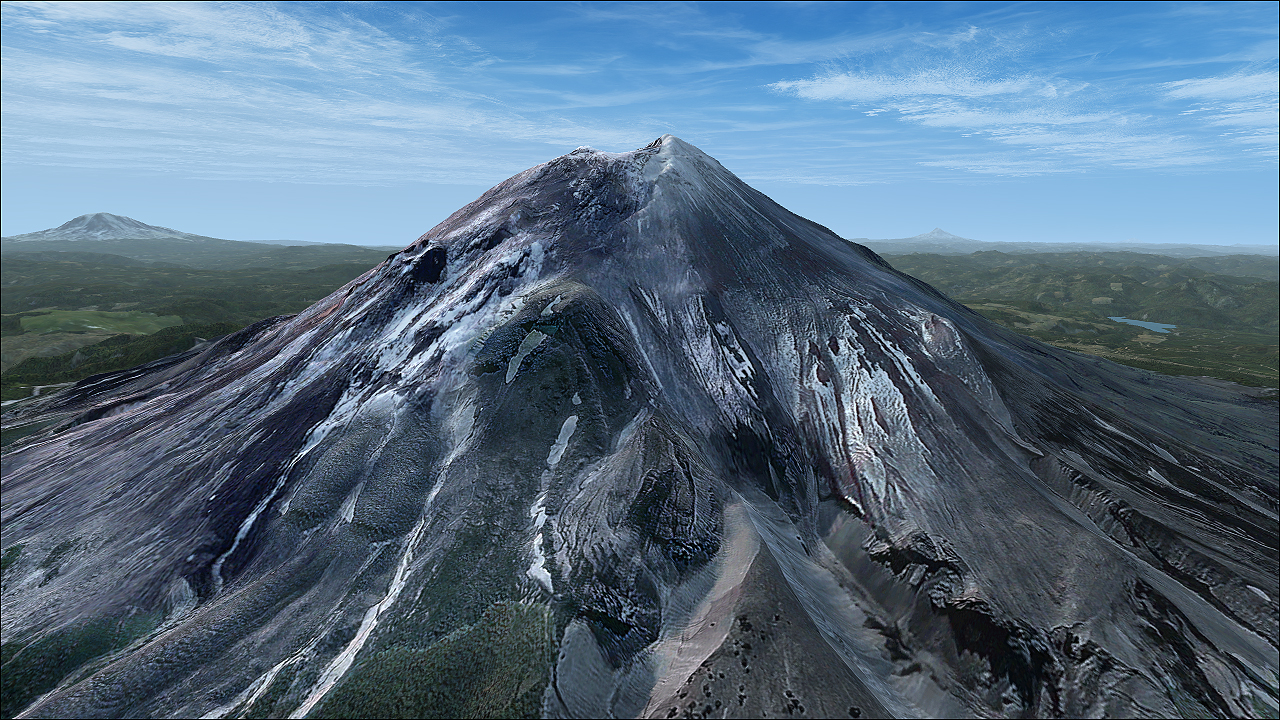


For fifty seven days, Mount St. Helens has been quaking, shaking, and belching. Her once pristine, snowy white Fujiyama-esque flanks are stained in hues of bluish grays and browns. Her north flank, once pristine and snow-capped, is a battered, bruised, bulging mass. Above the Sugar Bowl dome, an 850-foot-wide by 1,200-foot high scar is left behind by a collapsing slab of Leschi glacier, its cascading avalanche of ash and ice rockets over the Sugar Bowl dome and down the Forsyth glacier moraine in two lobes. That avalanche happened a week prior, the result of a 5.1 quake in the afternoon of May 12. It would become a "teaser" of impending apocalypse.
For the next five minutes, the landscape will be peaceful, serene, and eerily quiet. It is the last five minutes this landscape will ever look like this. In fact, witnesses there the night before said it was too quiet, even the sounds of wildlife were hushed.
+++
Over the course of the last week, I have been spending time working with a USGS aerial image of the peak, taken at 9 a.m. on May 17, and with the use of that aerial and two high-resolution orthophotos of Mount St. Helens's blast zone taken the first week of June, 1980, I have been synthesizing a digital ground overlay of Mount St. Helens to give it the look and appearance it had on that fateful Sunday in May before the cataclysmic eruption began.
Details such as that debris avalanche scar above Sugar Bowl, the cracks in the bulge in the upper reaches of Forsyth, Loowit, Leschi, and Wishbone glaciers (all four would disappear, and become the source of devastating mudflows and lahars that afternoon), and the ashen gray slopes are faithfully recreated to within 95% accuracy. Reference material for this package also includes the famous sequence captured by geologists Keith and Dorothy Stoffel, who were in a Cessna aircraft above the peak when it exploded, and photographer Gary Rosenquist's famous landslide/lateral blast sequence captured from a log landing 8 and a half miles northeast of the peak.
This has been a years-long dream of mine, which finally has come true. And I finally have the opportunity, very soon, to share that dream with the Flight sim community. The third of these images below, recreates a scene captured by USGS geologist Harry Glicken, who was to leave that observation post from which the real photo was taken the evening of May 17 (seen here: https://www.usgs.gov/media/images/mount-st-helens-may-17-1980-one-day-devastating-er). He would be replaced at 7 p.m. by geologist David Johnston. In a twist of ironic fate, Glicken, as he was departing for a post-doctorate speech he was to give in California on Monday, said to Johnston, "Perhaps it's best you're here instead of me. If I die here, nobody will remember me. If you die here, they'll name this ridge after you."
The ridge to which the observation post known as Coldwater II was stationed, which in 1980 had the name of South Coldwater Ridge, would be renamed Johnston Ridge a year later.