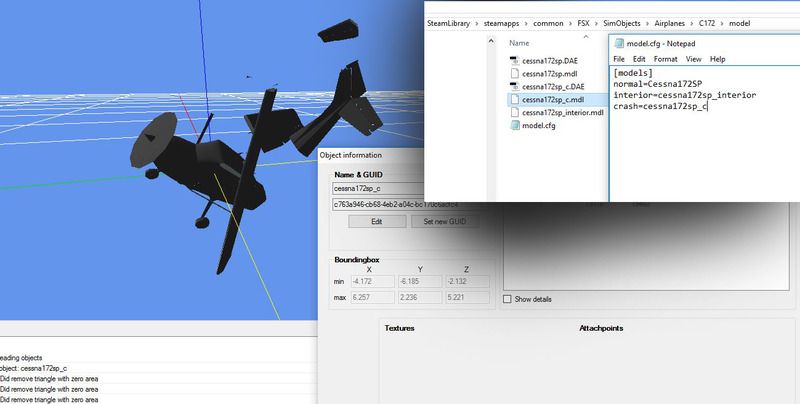
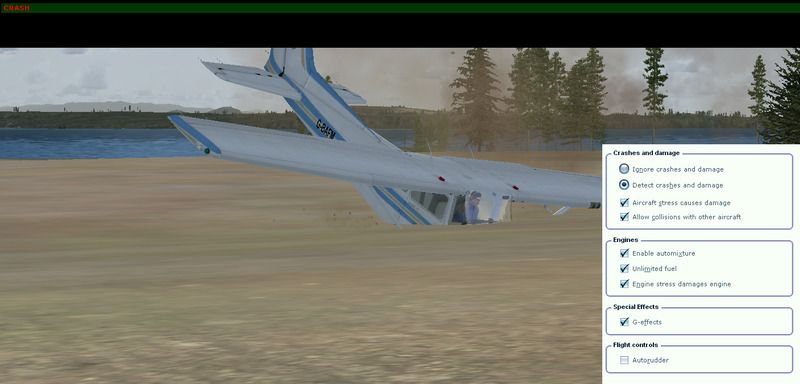
Actually, I do know what I am talking about and I've even verified it:
The whole point of the thread was functionality of crash models in P3D, please refer to the thread topic and relate your insults more on topic. We all know - thank you for re-educating us, that legacy versions of the sim supported crash simulation. Whether the functionality in P3D was implied due to future intentions, a cruel joke, or just plain laziness - or any number of other
possible implications, is moot imo, but way to beat a dead horse.
I will admit to being wrong about one thing: the crash model slot in model.cfg is not a back-compatibility feature, as separate crash models have been completely unsupported since FS2002. More on that in a bit. And, while it was not my intention to be insulting, my statement about your certainty being inversely proportional to your knowledge still stands: the reference to crash models reflects an older functionality from FS7 and previous (which used a separate crash model), and the text in the SDK was simply
never removed. This is something that I can easily prove. Firstly, the exact language in that particular section of the aircraft container SDK has been present since
at least the FS7 SDK. Perhaps it was absent from a previous P3D SDK, but it is present in the SDKs for FS7, FS8, FS9, and ESP.
Secondly, The crash model slot has been irrelevant since FS8, because FS7 was the last sim to support a separate crash model:
This is the default FS7 C182S, copied into FS8, and crashed into a building. This aircraft has, by default, a separate crash model file:
Which worked just fine in FS2000. Notice that it does not work as intended in FS2002. This is absolutely applicable to the topic of this thread, as it answers the initial poster's question:
Specifying a separate crash model in any sim after FS2000 will not accomplish anything, because separate crash models have been unsupported since FS2002, even though the language of the SDK has not changed. This applies to FSX, and most definitely also P3D. This brings us to the third part of our proof:
the P3D SDK makes it very plain in a separate section that the only way to enable visual damage is to have it built into the visual model and enter visual_damage=1 into the fltsim.x section of the aircraft configuration file. This was already directly quoted from the SDK in a previous post.
Aircraft built with the FS8 and FS9 SDK, with detachable "crash parts" specified and visual damage enabled in aircraft.cfg, will break apart in games built on the ESP platform (read: FSX, P3D) just fine:
The default aircraft in FSX appear to not fall apart, even with visual damage enabled in aircraft.cfg. I have created a simple test aircraft, and when parts are named according to the following list (from the FS9 SDK), exported as an FS9 model, they will fall off:
But there appears to be no way to tag these parts for detach-ability with an ESP-native model.
This means that, with respect to simulations based on the ESP platform, crash effects are fully supported when visual damage is enabled in an aircraft.cfg that has a corresponding model with detachable parts. It appears that only the FS8 and FS9 compilers can export such a model.
Again, my intentions are neither to be insulting nor combative, but I feel that your statements in this thread have been both inaccurate and arrogant.